About
Proyecto Elis

An open padel-specific teaching platform.

An open
platform!

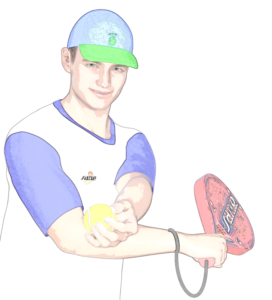
Saque de revésProyecto Elis is open to the participation of all those padel coaches or organisations whose knowledge represents an essential contribution to our sport.

Those who wish to spread their specific padel content —privately, publicly, commercially or free of charge— through a fully operational professional virtual campus, will always have an ally in Proyecto Elis.

This cooperative vision logically aims to give an opportunity to all technicians who want to complement their professional activity on court by also acting as tutors for their own online or combined —blended learning— courses.

Likewise, any organisations —federations, clubs, companies— can host their training activities on our campus —Moodle LMS— taking advantage of our combined expertise in padel and education.

Why Elis?

Athletes who wanted to participate in the ancient Olympic Games had to meet certain requirements, including having trained adequately for a period of several months immediately preceding the event. As a final part of their preparation, all athletes met in the town of Elis —near Olympia— the month before the Games under the supervision of the ‘helanódicas’, who advised and guided them, and subsequently umpired the competitions.

Like the athletes, the ‘helanódicas’ had to complete a 10-month training period before being able to perform their duties. It is this concept that we intend to make the main objective of the Proyecto Elis: the creation of elite coaches who are capable of mastering the specific knowledge necessary to teach and spread our sport in all areas, for all levels of play, for all ages, with different methodologies, researching and analyzing diverse sources and through multiple resources and formats of knowledge transfer.

Proyecto Elis is therefore an initiative that will provide resources and training activities designed to promote and sustain the development of padel worldwide.

The beginnings

Projecto Elis was born from the sum of the experiences of Martín Echegaray, who has assumed all kinds of technical and management responsibilities. His sporting expertise includes experiences as a professional player, pro coach, director, manager, national coach, and staff of sports brands. All of this has allowed him to have a clear vision of the educational needs in our sport.

After years of defining and organising the original ideas, Proyecto Elis started in 2016, when padel continued to grow in countries where it was already established, such as Argentina, Brazil, Spain and France, among others. On the other hand, it was also beginning to have an important activity in other countries.

In any case, education must be fundamental. In ‘traditional’ countries, so that padel can consolidate itself as a sport; and in ’emerging’ countries, so that the initial growth problems can be overcome and development can be ensured.

Our vision

Although we are aware that padel, as a ‘product’, is an excellent option, easy to practice, physically accessible, and with obvious advantages in terms of social aspects among others, we must not forget that it requires ‘sellers’ who know how to sell it in the best possible way. Well, these sellers are padel coaches, and therefore the greater, more varied and continuous their training is, the better they will perform their task.

In the process of development a sport, the figure of the coach has had, and will continue to have, a fundamental value.

The same approach is applicable to any entity involved in the development of padel. A structure in charge of such an objective must be made up of people who have knowledge of our sport, even to be able to adapt knowledge from other sciences to padel.

Ignoring this reality means facing a series of inconveniences and difficulties of various kinds, which in many cases end up being wrongly attributed to other factors, such as the lack of financial resources, to give just one example.

Proyecto Elis aims, with this vision, to cover different aspects of the process:

  1. Content creation.
  2. Research.
  3. Transferring specialized high-level knowledge (publications, courses, teaching programs).
Our Logo

Someone once told us that behind our name and logo there was a story to tell.

The olive

Oliva Elis

While the city of Elis was important because it was there that athletes completed their training for the ancient Games under the supervision of the best coaches, the olive tree was the symbol of success.

Today’s medals were olive branches in Olympia. This was probably because this tree and its fruit were the main source of sustenance for the Greek people, as is the case today in many other regions.

That is why the symbol of Elis is an olive tree, whose stem and leaf also represent a bird taking flight.

Capital letter ‘E’

Letras Elis

The letter ‘E’ is, at the same time, an arrow pointing downwards, in contrast to the bird represented by the stem and leaf of the olive tree, suggesting the upward path between our origin and the future we desire for our sport.

Typography

The search for the roots of organized sport, in this case in ancient Greek civilization, is attempted to be represented in typography.

Official and private certifications, and intrusive professionals

The difference between official and private certifications is an important issue that raises some controversies and from Proyecto Elis we want to make our vision clear and publicly.

In some countries, such as Spain, there are official regulations that define very precisely the features that sports qualifications must have in order to be able to recognize their academic and professional validity (with many nuances in the latter case).

These regulations arise from the competent authorities in the matter, being for example in Spain the central administration through the Higher Sports Council, or the sports federations themselves when requiring certain certifications to allow, for example, the participation of a coach on the benches giving instructions to their players.

However, private training is not prohibited —something that would be absurd, among other things— but, depending on the country, its scope is regulated, its offer is conditioned or, even on the contrary, it is recognized.

Spain, for example, has been the first country to formally contemplate official specific education in padel. And the regulations that govern it clearly establish the following for ‘non-official’ qualifications:

1. Entities that provide training in the field of physical activity and sport that does not lead to the obtaining of an official qualification will be subject to the current regulations that apply to them.

2. In said training, none of the names established for the certificates, cycles, degrees or official titles regulated in this Royal Decree may be used, nor those corresponding to the names of the education centres, nor any others that could lead to error or confusion with those.

3. The materials of the content holders, the formats and the sizes that they use to issue their diplomas or certificates will be clearly different from those established for official titles in Annex III of Royal Decree 733/1995, of May 5, on the issuance of academic and professional titles corresponding to the teachings established by Organic Law 1/1990, of October 3, on the General Regulation of the Educational System.

4. The advertising they issue must clearly indicate the non-official nature of the contents being taught and the diplomas or certificates issued upon completion.”

In this regard, it is the responsibility of the HSC, or the corresponding regional authority, to ensure compliance with the provisions of said Provision.

This is one of the reasons why Proyecto Elis does not promote basic or initial courses in countries where this type of regulations exists, and whose qualifications lead to confusion about the scope of the same and in the event of the slightest doubt, if for example it were basic courses in Spain, we would apply point four above.

However, we believe that continuous professional development is a cornerstone in the education of our coaches and the development of the sport itself, and that is why this is the backbone of our work, although of course we also collaborate in basic training with various federations and entities that call us, with the guarantees already mentioned.

The validity or not of specific training in different places gives rise to the controversy of professional ‘intrusion’ in the task of the padel coach. At this point it is important to clarify that the academic validity of the courses does not immediately equate to the possibility of working as a coach. This will depend on other regulations that, for example in Spain, have not been fully implemented. And even less so in other ’emerging’ countries in the padel world. Perhaps because of this confusion, the concept of intrusion is sometimes used in a poorly thought-out way, either to justify its existence or to try to turn it into something similar to a crime.

For all the above, our values ​​in reference to padel coaches education can be summarized in two principles:

  1. As padel coaches we must assume, respect, and also divulge the rules. This includes local regulations regarding sports qualifications.
  2. As padel coaches we must be aware that the time load of the sports qualifications that qualify us are not yet at the level that our sport deserve and therefore, out of basic respect for our own role and our sport, we must have a positive and permanent attitude towards our personal education.

© All rights reserved